
Nationwide: 020 3822 0600
Change Management Strategy - England Rugby Team
Unfortunately England’s dream to make Six Nations history by winning three times in a row has come to an end after their defeat to France!
James Haskell stated to The Telegraph (March, 2018) that the team hasn’t experienced two losses back to back before in one tournament and goes on to explain how important it is for them to keep their heads and confidence at the same time as accepting and understanding that there is work that needs to be done.
In October 2015 after England’s disappointing result in the Rugby World Cup we posted a blog about learning from your mistakes… three years on, we may as a team learnt from our original mistakes at the World Cup however have been faced with new challenges during the current Six Nations tournament.
Eddie Jones has commented on what needs to be done to improve as a team and what problems have arisen this season and has stated “It’s a problem we’ve got to fix… We can address it and keep getting better at it, but the reality is that we probably won’t get better at it until the World Cup.” This gives the England team just over a year to change their strategy and work together to fix their current state. Jones claims that the game of rugby has changed and that the team are not well equipped to handle it. Booz & Company (2010) explained that change is a people process “people are creatures of habit, hardwired to resist adopting new mind-sets, practices, and behaviours”. This supports Jones’ statement that the current England Rugby players are used to playing a certain way and the team are finding it hard to change their habits.
There are many pieces of research on how to successfully make change happen for a team… below are our TOP FIVE SUCCESS FACTORS
1. Understanding the need for Change
There are many reasons why teams and organisations need to or choose to change things.
It is obvious the need for change in the England Rugby Team and Jones has stated that he will be forced to change strategy and personnel to solve the problems that have arisen. It will be down to Jones and the rest of the England Rugby team to understand the change that will be introduced and the characteristics of the change.
2. Situational Awareness of the Change (Prosci 2018)
As a manager about to implement change, it is important to be aware of how the change will affect the team, important factors to think about are: How big is the change? Who will it affect? What is being changed? What is the timeframe for the change? And why do we need to be aware of the change? This brings us nicely onto the other three success factors…
3. Involve Every Layer (Jones, Aguirre and Calderone, 2004)
Change will affect different levels of the organisation, in England Rugby Team’s example, change will affect everyone from the players, coaching team, sport science team and management team. In each “sub team”, there are experts in their fields who can help contribute to the strategy change. Conley (2014) claims that involving and engaging your team in the planning stage of change creates a sense of ownership in the plan outcome, resulting in a high level of engagement and commitment to the success of the plan.
4. Build an Emotional and Rational Case for Change (Booz & Company, 2010)
The England Rugby Team have a very public rational case for change which each member will be committed to due to the emotional attachment. Eddie Jones can explain and make people aware of the changes that need to happen but at the end of the day the players’ emotions is where the momentum for real transformation ultimately lies.
Jonny May reported on the emotional attachment to their recent Six Nations performance… “People support us and we have an opportunity when we wear that shirt to inspire them and it hasn’t been good enough in the last couple of weeks”.
5. Well-defined Milestones and Metrics (iMindq, 2015)
Every goal needs milestones to help monitor and control initiatives that implement the strategy. Milestones and metrics will vary depending on the amount of change happening, who it will affect and if there are any deadlines as a team. As previously mentioned Eddie Jones has explained that the team’s current problems will not be fixed until next year’s Rugby World Cup, however within this milestone there will be lots of smaller milestones to help achieve this goal.
Change can be difficult to any team or organisation, it is important for those implementing change to have a successful change management strategy in place to ensure smooth transitions and to help keep their team motivated. Here at The Teambuilding Company, a lot of our clients come to us to help provide them with fun and bonding activities for their team which can help with the changing process.
Indoor
Together We Can


Overview
Co-operative Team Building
Our Together We Can event embodies the true ethos of team building; each team contributes to a common goal and must communicate effectively in order to achieve success. The brilliance of this event - it is pure teambuilding theory made fun!
The event promotes co-operation through a variety of non-competitive team building activities. Each team contributes to one large task, communicating their work to the next team in a briefing at the start/end of each challenge.
About
Event Format
Teams rotate around the four challenge zones, spending up to an hour at each zone, adding their contribution to each task. When the time is up they must spend 5 minutes explaining their work and handing over to the next team.
Team Challenge 1 – Canvas Art
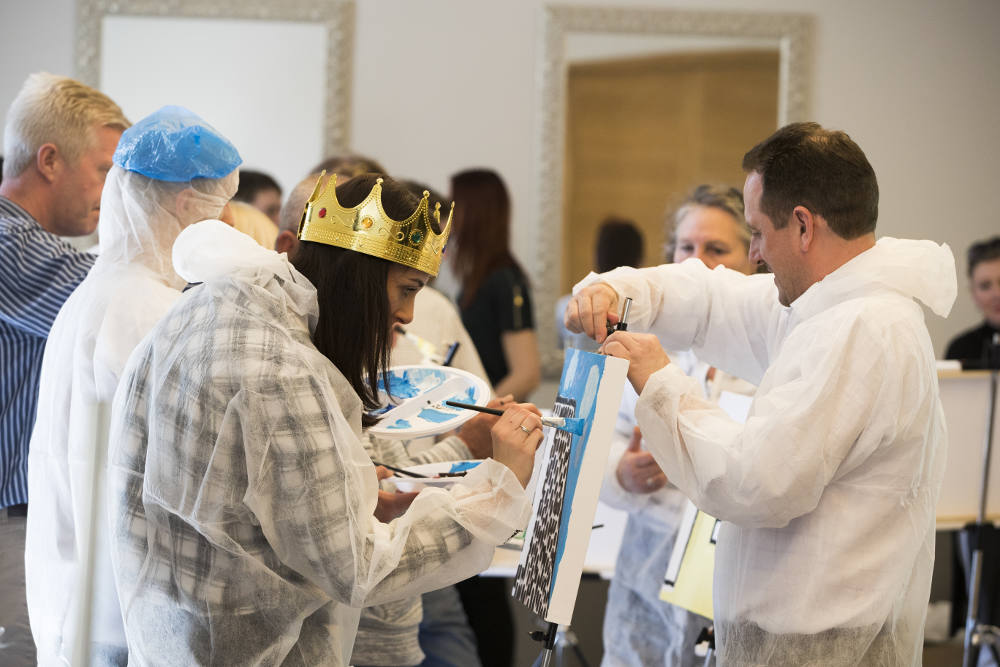
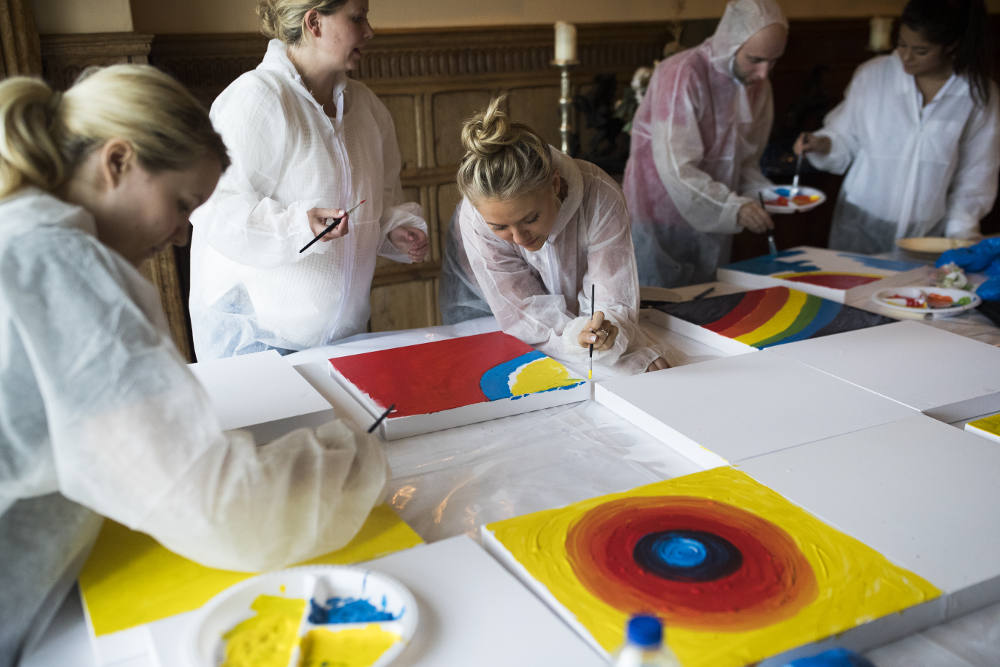
Each team is presented with a giant canvas and acrylic paints. The team must then work together to create a section of the overall design.
Team Challenge 2 - Rollercoaster Challenge
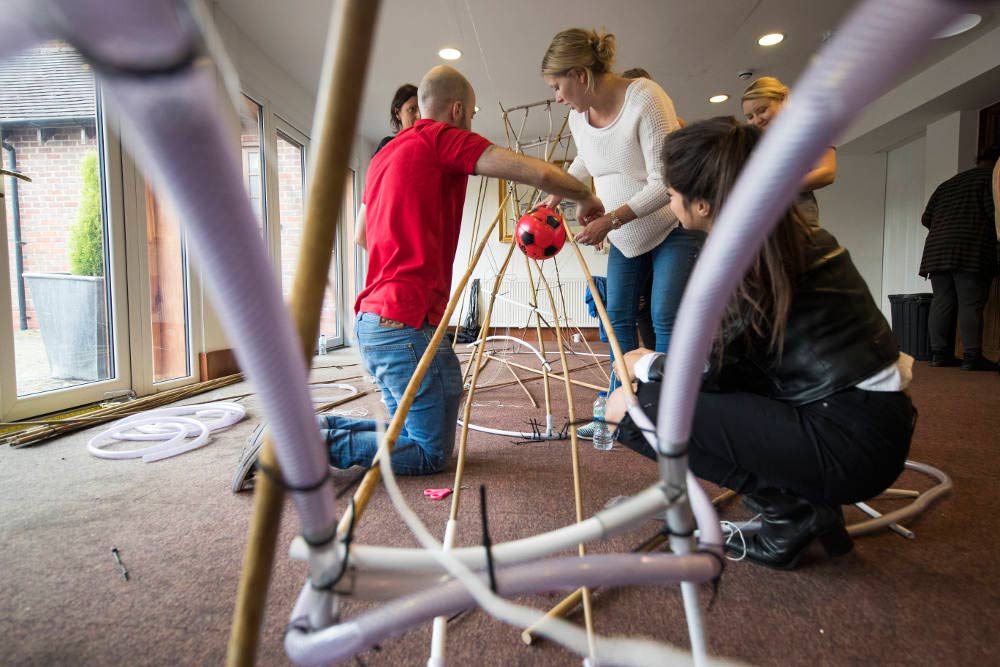
Next, construct a working rollercoaster which carries a ball for over 30 seconds under its own momentum. Build a section of the design, including quirky engineering, which forms part of the overall contraption.
Team Challenge 3 - Commercial Break
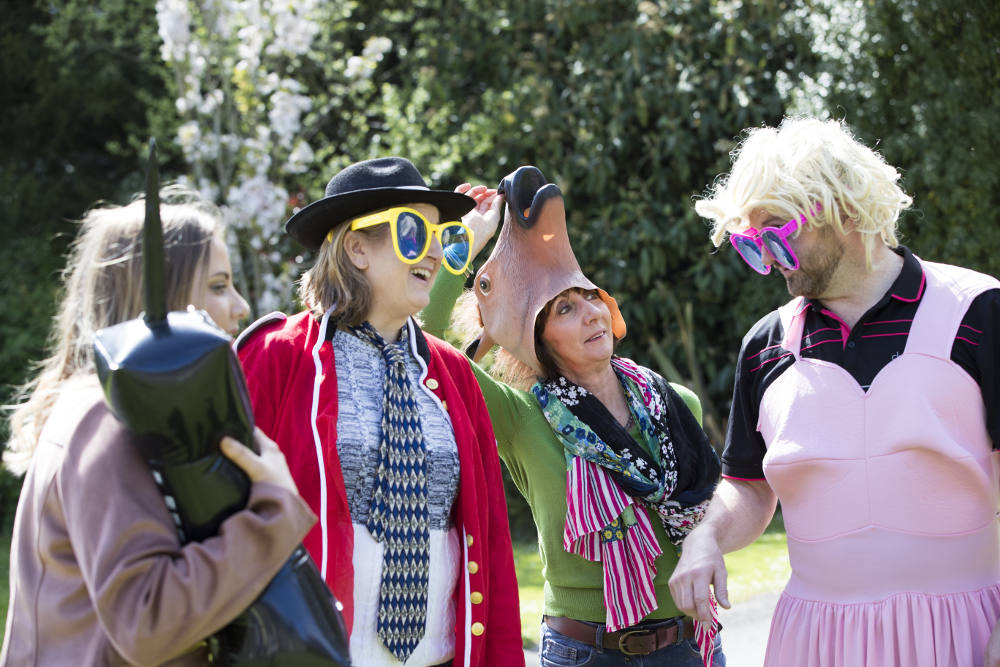
Each team films a section of a movie. The following team will watch the last 10 seconds and follow on in sequence. Continuity is vital so actor positioning and fancy dress must be matched between teams.
Team Challenge 4 - Think Outside The Blox
We give you literally thousands of LEGO bricks and free reign to build whatever you like. Some teams choose their company logo, others something more abstract. The end result is LEGO, but on a massive scale.


1 of 9
About
More Details
For the finale, the teams come together for a grand unveiling. They will see their completed Da Vinci's Masterpiece, watch as the ball rolls perfectly down the Rollercoaster, laugh at the brilliance of their video and enjoy the completed LEGO Sculpture.
How it works
How does Together We Can work?
Together We Can is a non-competitive indoor team building event for 20 to 150 people, where every team contributes to four shared projects and briefs the next team on its progress. It lasts about four hours. Here's how it runs.
-
Canvas Art
Teams work on a giant canvas with acrylic paints, each creating a section of the overall design.
-
Rollercoaster Challenge
Teams build a working rollercoaster that carries a ball for over 30 seconds.
-
Think Outside the Blox
Teams use thousands of LEGO bricks to build anything from a company logo to something more abstract.
-
Commercial Break
Each team films a section of a film, and the next team carries on in sequence, so continuity is key.
-
The grand unveiling
Everyone comes together to see the finished canvas, watch the rollercoaster run, enjoy the film and admire the LEGO sculpture.
What's included
What's included with Together We Can?
Together We Can includes all four activity zones and everything needed to run them.
-
Four activity zones
-
Over 20,000 LEGO bricks
-
All activity equipment
-
Event management and experienced instructors
Optional extras
-
+
Event photography or filming
-
+
Bespoke picture design for the canvas art
-
+
Team clothing: shirts, caps and more
Benefits
What are the benefits of Together We Can?
Together We Can is pure team building theory made fun, building cohesion and creativity through shared goals.
-

Team cohesion
Every team contributes to a common goal, so success depends on everyone.
-

Creativity
Painting, building, filming and engineering give everyone a chance to create.
-

Broad appeal
Non-competitive and varied, with something for every personality.
-

Link to business objectives
Briefing the next team mirrors handovers and communication at work.

I thought that the event was very well organised and really engaging. The tasks were really varied and that allowed us to keep focussed. The team were willing to work with us and try and tailor the day towards a specific theme.
Syngenta
FAQs
Together We Can: Frequently Asked Questions
Together We Can is a cooperative indoor team-building event in which every group contributes to four shared projects. Instead of trying to defeat one another, teams inherit work from their colleagues and improve it for the next group.
The activity zones involve creating a collaborative canvas, constructing a gravity-powered rollercoaster, filming a continuous movie and building a large-scale LEGO sculpture.
At the end of each rotation, teams receive approximately five minutes to explain what they have completed and brief the incoming group. A poor handover can undo good work, making communication between teams essential.
Teams paint part of a much larger design on a giant canvas. Individual sections eventually come together as one collaborative artwork, so colour choices and positioning need to connect with work completed by other groups.
Each team adds to a structure designed to keep a ball moving under its own momentum for more than 30 seconds. New builders must understand the existing track before extending it with their own ideas.
Teams film separate sections of one continuing movie. Each group sees only the final seconds of the previous scene, so costumes, actor positions and story continuity need to be handed over accurately.
Participants use thousands of bricks to develop one large shared sculpture. Groups may choose a recognisable company design or something more abstract, but every rotation needs to respect and extend what is already there.
No. Success depends on the final quality of the four shared projects rather than one team beating another. The format is ideal for organisations that want cooperation without a scoreboard dominating the day.
The event runs for approximately four hours. Teams rotate through all four zones, spending up to an hour contributing to each project before the final unveiling.
Together We Can is suitable for approximately 20 to 150 participants. The rotation system allows larger groups to stay actively involved while contributing to the same four collective outcomes.